

The $8 million blunder
That Tuesday phone call still haunts me. Sarah from MegaCorp (not their real name, obviously) was practically whispering into the phone at 2:30 PM. “We screwed up big time,” she said. “Can you come in? Like, tomorrow?”
Eighteen months and $8 million later, their diversity program wasn’t just failing—it was making things actively worse. Employees were more divided than before. Three top performers from underrepresented groups had quit, citing the “fake corporate theater” around inclusion. The mandatory training sessions had become places where people went to check boxes and mentally disengage.
I’ve been doing this work for over a decade now, and I keep seeing the same car crash happen in slow motion. Companies throw serious money at diversity equity and inclusion consultants in USA companies, follow what looks like a smart hiring process, then watch everything fall apart. There’s actually research showing that about 70% of these initiatives don’t hit their targets within two years. That’s not just disappointing—it’s brutal for the people these programs are supposed to help.
But here’s the thing that really gets to me: these failures aren’t random bad luck. They follow patterns you can spot from a mile away if you know what to look for.
Why most organizations get DEIB consultant selection wrong
Remember the last time your company hired consultants for anything else? Operations, IT, strategy—whatever. You probably did an RFP, checked credentials, called references, picked based on methodology and price. Standard playbook that works great for most consulting gigs.
Except diversity work isn’t like other consulting. It’s not a technical problem you can solve with frameworks and best practices. You’re dealing with people’s deep-seated beliefs, office politics that go back years, and conversations that most executives would rather avoid entirely.
I watched this play out last year with a tech company in Austin. Their selection committee treated the diversity consulting RFP exactly like they’d approach supply chain optimization. Detailed scorecards, weighted factors, the whole nine yards. They picked the consultant with the most impressive PowerPoint and client list—someone who’d worked with three Fortune 100 companies and published academic papers.
Six months in, the program was basically dead. The consultant was smart as hell but couldn’t read the room. They rolled out cookie-cutter solutions that worked perfectly at Microsoft or Google but completely missed what made this particular company tick. Different history, different challenges, different readiness for change.
What I’ve figured out is that traditional vendor selection actually filters out the qualities that make DEI consultants effective. You end up rewarding slick presentations over genuine connection, big-name clients over cultural intuition, fancy degrees over street smarts about how organizations actually change.
So companies wind up with inclusion specialists who can diagnose your problems beautifully but stumble when it comes to fixing them. Or bias mitigation strategies that look brilliant on paper but crumble the moment they hit workplace reality.
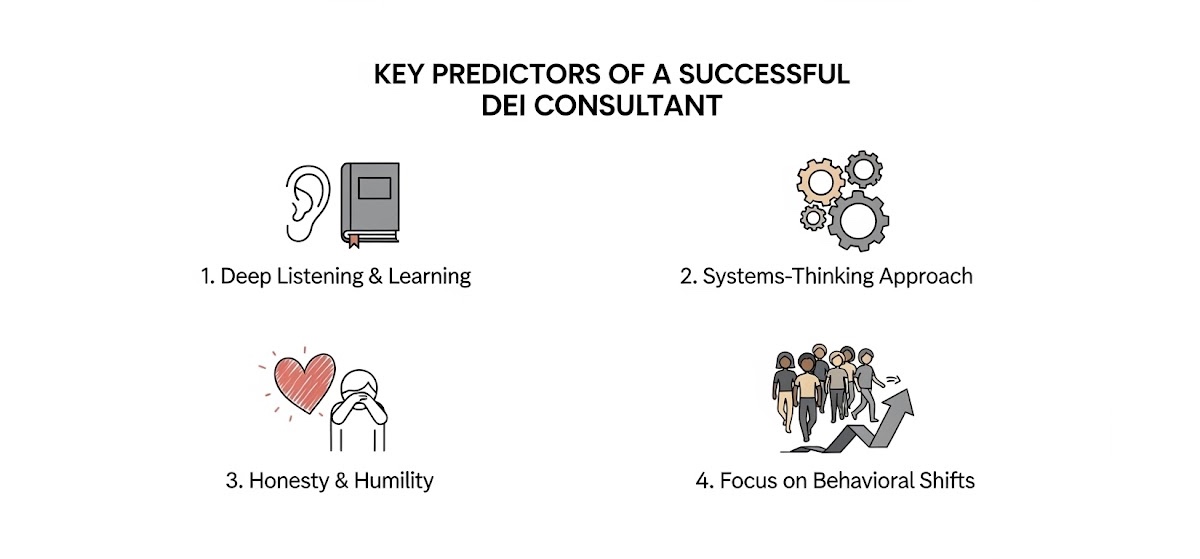
What actually predicts DEI consultant success
After watching dozens of these engagements—some amazing, others complete disasters—I’ve started noticing patterns that most hiring committees totally miss. The consultants who actually transform organizations rarely look like what you’d expect.
Take Maria. When I was helping a healthcare client evaluate diversity consulting firms, I almost dismissed her proposal. Half the length of everyone else’s. No Harvard MBA. Client list wasn’t packed with household names. But she had something I’d learned to value way more: she insisted on understanding before doing anything.
While other consultants pitched comprehensive 12-month programs, Maria wanted to spend her first month just listening. Confidential interviews with people at every level. Sitting in on team meetings. Understanding the unwritten rules before designing any training or policy changes. Seemed inefficient compared to consultants promising to hit the ground running.
Eighteen months later? Most sustainable culture change I’ve seen in years. Employee engagement scores for underrepresented groups up 23%. But more than that—the changes felt natural, not forced. People weren’t just following new policies; they were genuinely thinking differently about inclusion.
The consultants who consistently deliver results share some interesting traits:
They ask way more questions than they answer. The best diversity and inclusion consultants I work with spend at least a third of their time in detective mode. They’re not rushing to implement—they’re trying to decode your organization’s specific DNA.
They’re honest about what they don’t know. I’ve seen mediocre consultants try to be everything to everyone. Great ones know when they’re out of their depth and either bring in specialists or recommend different approaches entirely.
They target systems, not souls. The most effective inclusion consulting services go after organizational machinery—how you hire, evaluate performance, run meetings—rather than trying to change people’s hearts through training alone.
Here’s what I’ve learned matters vs. what most people focus on:
What selection committees typically prioritize:
- Big-name client roster
- Advanced degrees and certifications
- Comprehensive service menus
- Polished pitch presentations
- Lowest cost per deliverable
What actually predicts success:
- Solid cultural assessment process
- Systems-thinking approach
- Willingness to start slow and build foundations
- Genuine stakeholder engagement skills
- Long-term relationship mindset
This completely changed how I advise clients on vetting potential partners. Credentials still matter—they’re just table stakes, not differentiators.
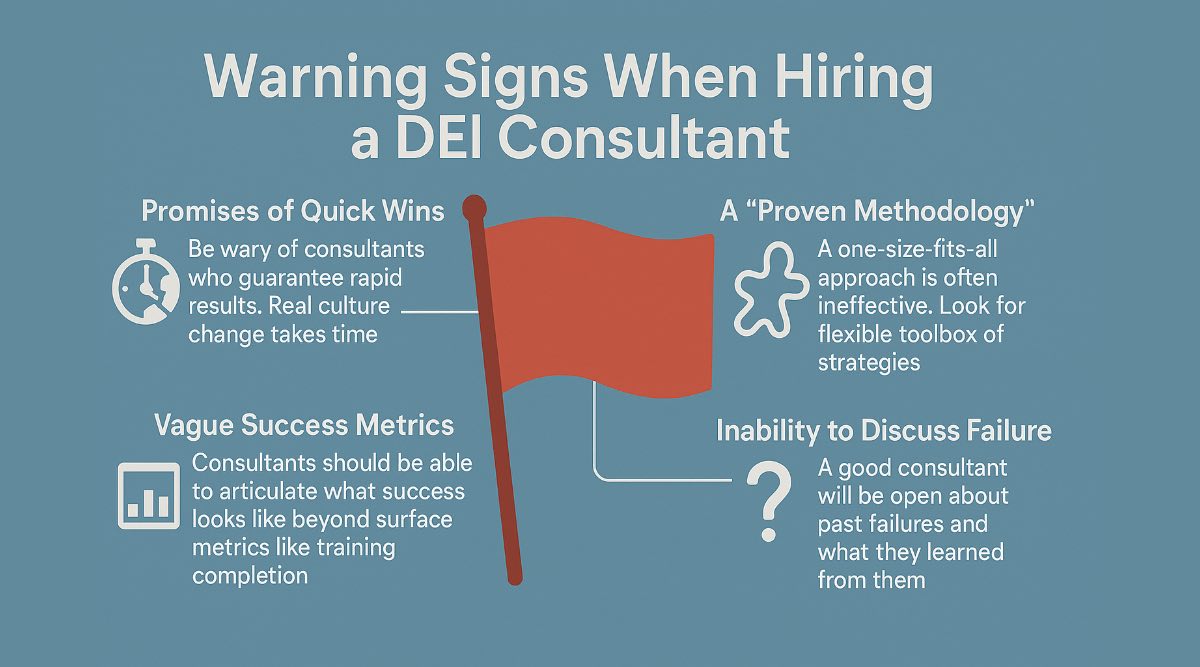
Red flags when hiring diversity equity and inclusion consultants
I wish spotting problematic DEI consultants was straightforward, but some of the worst patterns disguise themselves as strengths. Over the years, I’ve developed what my colleagues call my “BS detector”—warning signs that consistently predict program failure, no matter how impressive someone looks on paper.
Biggest red flag? Consultants who promise quick wins. I sat through a pitch once where the guy literally guaranteed “measurable culture change within 90 days.” The leadership team loved hearing that, especially with their quarterly pressure and board expectations. But culture doesn’t work on quarterly timelines. Consultants who promise otherwise are either clueless or lying.
Another warning sign: spending more time talking about other clients than asking about yours. During one selection process, a big-name diversity consulting firm burned 45 minutes of their hour presentation name-dropping Fortune 500 clients and describing programs they’d done elsewhere. When we finally asked about our specific challenges, they basically said, “We’ll adapt our proven methodology.”
That phrase—”proven methodology”—makes me nervous now. The most effective unconscious bias consultants I know don’t have one methodology. They’ve got a toolbox they customize based on where you are, what your culture’s like, what specific problems you’re facing. One-size-fits-all might work for process improvement, but it often backfires with inclusion work.
I also watch how consultants talk about resistance. Bad ones either pretend pushback won’t happen or act like training can overcome any objection. Good consultants expect resistance, plan for it, have sophisticated strategies for working with skeptics instead of trying to go around them.
Maybe most telling: problematic consultants can’t articulate what success looks like beyond surface metrics. They’ll show you training completion rates or survey satisfaction scores, but they struggle to describe the behavioral shifts that indicate real progress.
Last year, I watched a consultant present gorgeous charts showing 95% training completion and 4.2/5.0 satisfaction scores from their previous client. Looked impressive until we found out that same client had 40% turnover among underrepresented employees during the program. High training scores don’t mean much if people are still leaving because they don’t feel valued.
The questions that separate quality inclusion consultants from the rest
I’ve discovered that the right questions during consultant selection reveal more about capabilities than any amount of credential checking or reference calls. These aren’t trick questions—they’re strategic ways to understand how consultants think, work, and handle the inevitable challenges that come up during DEI work.
My go-to question: “Tell me about a time when a diversity initiative you were leading hit serious resistance from senior leadership. What happened, and how did you handle it?”
The responses are incredibly revealing. Weak consultants often can’t provide specific examples, or they describe situations where they won over resistant leaders purely through data and logic. Strong consultants tell complex stories about navigating organizational politics, acknowledging legitimate concerns while still pushing inclusion forward, sometimes making strategic compromises for long-term gains.
I also ask: “What would make you recommend that an organization postpone or redesign a planned DEI initiative?” This shows whether consultants have enough integrity to walk away from revenue when a client isn’t ready. The best diversity program implementation specialists I know have turned down projects because they recognized the organization lacked what it needed to succeed.
Another critical one focuses on measurement: “How do you tell the difference between performative changes and genuine culture shifts?” Strong consultants have sophisticated ways of recognizing real transformation versus compliance theater. They understand that authentic inclusion work sometimes involves temporary dips in satisfaction scores as buried tensions surface and get worked through.
Questions that reveal consultant quality:
How do you handle senior leadership resistance? Strong answers include specific examples, political awareness, long-term thinking
When would you recommend delaying a DEI initiative?
Look for clear criteria and organizational readiness frameworks
How do you measure real culture change? Should include behavioral indicators, not just survey data
Tell me about your biggest failure in this work Self-awareness and continuous learning mindset
How do you adapt your approach for different industries? Industry-specific insights, flexible methodology
The most illuminating question I ask: “What’s your biggest failure in this work, and what did you learn?” Consultants who can’t share genuine examples of setbacks are either inexperienced or lack the self-awareness complex change work requires. The best ones tell stories about initiatives that went sideways, clients they couldn’t help, hard-won lessons about organizational dynamics.
One consultant I really respect described a bias training program that actually increased tension between employee groups. Instead of defending her approach, she paused the program, did more stakeholder interviews, redesigned everything based on what she learned. That intellectual humility and adaptability is exactly what messy inclusion work demands.
What success looks like when working with diversity consultants USA and Australia
After years watching DEI initiatives succeed and fail, I’ve got realistic expectations about what effective workplace culture transformation actually looks like. It’s messier, slower, more complicated than most organizations expect—but also more sustainable and impactful when it’s done thoughtfully.
Real success doesn’t announce itself with dramatic before-and-after stories. Instead, it shows up gradually through shifts in daily interactions, decision-making, organizational assumptions that people might not even notice initially.
I think about Jennifer, whose three-year partnership with a skilled equity training specialist produced changes that weren’t obvious until we looked back at the data. Employee retention among underrepresented groups improved 31%. More interesting, innovation metrics increased substantially—40% more patent applications, two breakthrough products from cross-functional teams that previously couldn’t collaborate effectively.
But here’s what struck me: when I asked employees to describe the changes, they had trouble pinpointing specific moments or interventions. The transformation felt organic, almost inevitable. People mentioned feeling more comfortable speaking up in meetings, managers talked about making different assumptions about team capabilities, leadership described richer strategic conversations incorporating perspectives they’d previously missed.
This natural quality is actually typical of effective diversity consulting partnerships. The best inclusion strategy development creates changes that feel like they grew from within rather than being imposed from outside.
Realistic timelines for meaningful progress run 18-36 months, not the 6-12 month windows most leaders prefer. First 6-9 months involve diagnostic work, relationship building, laying foundations. Real behavioral changes usually show up around month 12-18. Systemic transformation takes two to three years to fully develop.
Investment levels vary based on organization size and scope, but successful partnerships typically need annual budgets of $150,000-$500,000 for mid-sized companies (1,000-10,000 employees). Might seem like a lot, but it’s a fraction of what organizations lose through turnover, reduced innovation, legal risks when inclusion problems go unaddressed.
The most meaningful ROI measurements focus on leading indicators rather than lagging ones. Instead of waiting for annual engagement surveys, effective measurement systems track participation patterns in meetings, diversity of voices in strategic decisions, speed with which concerns get raised and resolved.
What success definitely doesn’t look like: universal buy-in, conflict-free implementations, dramatic sentiment score improvements within the first year. Organizations expecting these outcomes set themselves up for disappointment and might abandon effective programs before they mature.

Making the right choice: selecting diversity and inclusion consultants that deliver
The consultant selection process can either build the foundation for transformational change or create obstacles that undermine even well-designed programs. After guiding dozens of organizations through this process, I’ve learned that how you choose matters as much as who you choose.
The most successful selection processes involve stakeholders from multiple organizational levels, not just senior leadership. I always recommend including high-potential employees from underrepresented groups, middle managers responsible for day-to-day implementation, influential informal leaders who can make or break culture change initiatives.
This broader involvement serves multiple purposes. Ensures consultant selection considers diverse perspectives and needs. Also starts building buy-in for the eventual program before formal initiatives launch. When people feel heard during selection, they invest more in making the partnership successful.
I strongly advocate for pilot projects or phased engagements rather than comprehensive long-term contracts upfront. The best workplace equity programs evolve based on what organizations learn about themselves during initial stages. Consultants who resist pilot approaches often lack confidence in their ability to demonstrate value quickly.
One of my most successful client relationships started with a three-month diagnostic engagement we could extend or conclude based on mutual fit and early results. This protected the organization from potentially costly mismatches while giving the consultant space to demonstrate capabilities without massive long-term commitment pressure.
The client insisted on measurable milestones every 90 days, which felt constraining initially but ultimately helped both parties stay aligned on progress and expectations. By month nine, both organization and consultant were confident enough to commit to a comprehensive three-year partnership that became a model for other companies in their industry.
Geographic considerations matter more than many organizations realize. While remote consulting has become common, the most effective diversity consulting services still require significant on-site presence, especially during diagnostic and relationship-building phases. Consultants who understand local cultural dynamics, regional business practices, community contexts often achieve better results than those applying generic national approaches.
For organizations operating across multiple locations, I recommend consultants who can demonstrate experience with distributed implementation strategies and have local partners or team members in key regions rather than trying to manage everything centrally.
The financial structure of consultant partnerships deserves careful consideration. I’ve seen organizations trapped in arrangements that incentivize consultants to extend engagements unnecessarily, while others create structures pressuring consultants to show results too quickly. Most effective arrangements align consultant compensation with meaningful organizational outcomes rather than just activity metrics.
What I tell every client: choose consultants you’d want to work with during your organization’s most challenging moments, because that’s inevitably when you’ll need them most. Technical expertise matters, but resilience, adaptability, genuine commitment to your success matter more long-term.
The right diversity and inclusion consulting partnership can accelerate organizational transformation in ways internal efforts alone rarely achieve. But success requires choosing partners who understand that sustainable change happens through relationships, not just programs.
If you’re ready to explore how the right consulting partnership might benefit your organization, start with an honest assessment of your current readiness and specific challenges.
Contact us here: https://1diversity.com/contact-us to discuss how we might support your journey toward more inclusive, equitable workplace culture.
The conversation might just save you from your own $8 million mistake.


